Ever get a toothy little face in a chat and wonder if it was a joke or a jab?
Your friend sends a photo of their new haircut, then adds a goofy toothy face. Is that a joke, a compliment, or a dig? Moments like this send people to Google to search “buckteeth emoji.”
The confusing part is that there’s no single official one. People mix smiley faces, cute animals, and one famous meme image to get the same look.
Once you know what each choice says, you can read these messages with confidence and send your own without second guessing. Let’s start with what they actually mean.
“A toothy grin can be a joke, a hug, or a shrug, depending on who sends it.”
What do buckteeth emoji mean?
Buckteeth emoji usually mean silly, playful, or a little awkward. There is no official Unicode version, so people borrow toothy faces like 😁 and 😬, animals like 🐰 and 🦫, and a viral meme image. Most of the time the message is “I’m being goofy.” Sometimes it means “I feel dumb,” and now and then it’s a tease.
Unicode is the shared standard that gives every emoji its own code, so a message can travel from one phone to another. It does include a tooth, 🦷, added in 2018, but no dedicated buckteeth face. That gap is why people improvise.
To find any of these, open your emoji keyboard and type a keyword like “grin,” “rabbit,” or “tooth.” You can also copy and paste them straight from this page.
Texting strips out tone of voice, which is why a toothy face can be tricky. In person, you’d see the smile. In a chat, the emoji has to do that job, so the words around it matter a lot.
The best known buckteeth image isn’t a real emoji at all. It started as a stock vector graphic, then went viral as a meme around 2023, often to joke about feeling foolish. Sending it at someone else can read as calling them stupid, so aim it at yourself first.
The toothy family shifts with context. 😁 is the safest pick: warm after good news, a bit smug after a joke at someone’s expense.
😬 shows teeth too, but it says “yikes.” A friend might send it after a small mistake, while a coworker might mean real discomfort.
🐰 and 🦫 lean on the animal look. The rabbit reads sweet, while the beaver reads funnier. Next to 😁, the 🦷 can tease a big smile, and adding 🥺 softens almost any toothy joke.
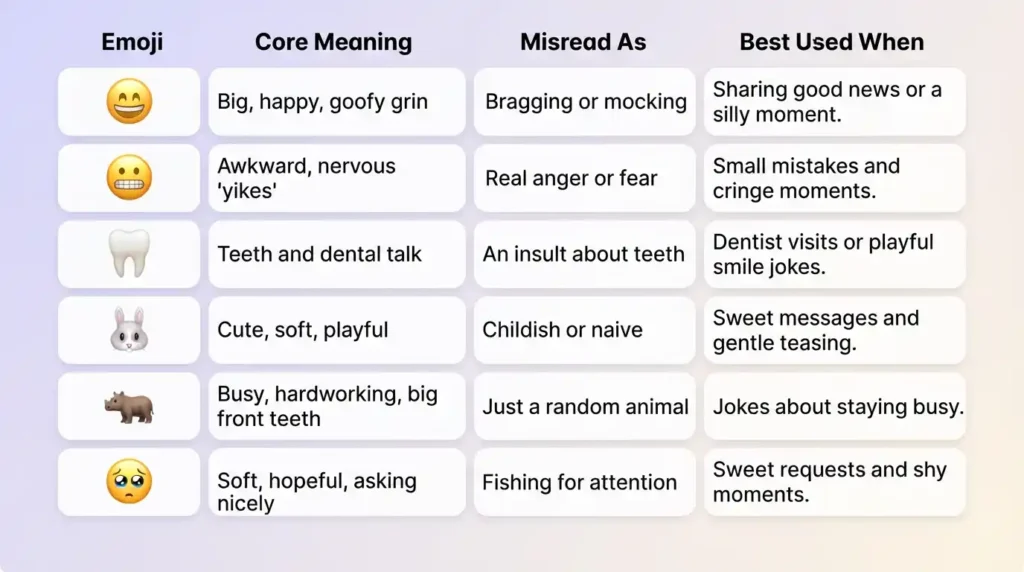
Table
| Emoji | Core meaning | Misread as | Best used when |
| 😁 | Big, happy, goofy grin | Bragging or mocking | Sharing good news or a silly moment |
| 😬 | Awkward, nervous “yikes” | Real anger or fear | Small mistakes and cringe moments |
| 🦷 | Teeth and dental talk | An insult about teeth | Dentist visits or playful smile jokes |
| 🐰 | Cute, soft, playful | Childish or naive | Sweet messages and gentle teasing |
| 🦫 | Busy, hardworking, big front teeth | Just a random animal | Jokes about staying busy |
| 🥺 | Soft, hopeful, asking nicely | Fishing for attention | Sweet requests and shy moments |
More Meanings
😁 Beaming Face With Smiling Eyes
Meaning: A big, happy grin with teeth showing.
Example 1: Got the job 😁
Example 2: Someone brought cookies to the office 😁
😬 Grimacing Face
Meaning: An awkward or nervous “oops” moment.
Example 1: I just replied all by mistake 😬
Example 2: The meeting starts in two minutes 😬
🦷 Tooth
Meaning: Teeth, dental care, or a joke about smiles.
Example 1: Dentist at 9 tomorrow 🦷
Example 2: Flossing streak, day 12 🦷
🐰 Rabbit Face
Meaning: Something cute, gentle, and playful.
Example 1: Weekend plans are naps and snacks 🐰
Example 2: You looked adorable today 🐰
🐭 Mouse Face
Meaning: A small, shy, or quietly cute mood.
Example 1: Sneaking out of the party early 🐭
Example 2: Hiding under a blanket all day 🐭
🐹 Hamster Face
Meaning: Chubby cheeked cuteness and snack energy.
Example 1: Me with a bag of chips 🐹
Example 2: Cheeks full of birthday cake 🐹
🦫 Beaver
Meaning: Big front teeth and busy, hardworking energy.
Example 1: Working late again 🦫
Example 2: Building this project all weekend 🦫
🐿️ Chipmunk
Meaning: A quick, cheerful, energetic little friend.
Example 1: Running errands all morning 🐿️
Example 2: Saving snacks for later 🐿️
🥕 Carrot
Meaning: A rabbit’s favorite snack, used for a bunny theme.
Example 1: Lunch is just a carrot today 🥕
Example 2: Feeding my inner rabbit 🥕
🥺 Pleading Face
Meaning: Soft, hopeful, or asking for something sweetly.
Example 1: Can you save me a seat 🥺
Example 2: I missed you today 🥺
How to use buckteeth emoji the right way
The same toothy face can land differently depending on where you send it. Here’s how each app tends to work.
WhatsApp is personal, so people lean on softer faces like 🐰 and 🥺 with close friends and family. Long chats leave room for jokes, and a single 😁 keeps the mood light. Most WhatsApp emojis also work well as quick reactions. In a family group, a 🐭 or 🐹 can make a small message feel warm, while a plain 😁 is usually enough with coworkers.
Instagram is all about captions and comments. A 🐰 or 🐿️ in a caption adds a cute tone to a photo, and a 😁 under a friend’s post says “love this.” Instagram emojis act like a tiny mood board, so keep the set small and matching. Stories and replies are a good spot for 😬 when a moment goes wrong in a funny way, and a quick 🐰 in the comments feels like a friendly nod.
TikTok
TikTok comments move fast and lean on humor. 😬 fits awkward videos, and a toothy grin shows up when a creator says something silly. Irony is common, so a sweet emoji can carry a joke as easily as a compliment. If a trend calls for playing dumb, a toothy grin in the comments says you’re in on the joke. Read the room, because the same emoji can feel friendly or sarcastic.
One more thing to know: the same emoji looks a little different on each phone. Apple, Google, and Samsung draw their own versions, so your grin may look bigger or goofier on the other end.
Dos
- Use the emoji when it matches the emotional tone.
- Consider your relationship with the person.
- Use combinations that feel natural.
Don’ts
- Do not overload serious messages with emojis.
- Do not assume everyone interprets an emoji the same way.
- Do not use an emoji combination that changes the intended tone.
- Do not use the emoji to mock how someone looks.
Best buckteeth emoji combos to copy and paste
Tap, copy, and paste these into any chat. They work as copy-paste emojis for texts, captions, and comments, and the sweet ones make good romantic emojis without a single heart.
Romantic
👉 🐰🥺 A soft “thinking of you” text
😁🥺 A thank you after a great date
👉 🐹😁 A gentle reply to a sweet compliment
Cute
👉 🐰🥕 A snack photo or cozy morning caption
🐿️😁 A cheerful comment on a friend’s pet picture
👉 🐭🐹 An “aww” moment in the group chat
Flirty
👉 😁🦷 A playful “that smile though” compliment
😬🥺 Shy interest when you don’t know what to say
👉 🦫😁 Teasing someone who just made you laugh
Missing someone
👉 🐭🥺 A quiet “I miss you” to a friend
🐹🥺 A “come home soon” to your partner
👉 🐿️🥺 A check in with someone far away
Good night
👉 🐭😁 A friendly “sleep well” after a long chat
🐰🐹 A cozy “sleep tight” for someone close
👉 🦫🐰 A good night to a friend with a busy week
Mix and match as you like. Put 🥺 last for a softer ending, or 😁 last for a lighter one.
Trending buckteeth emoji in 2026
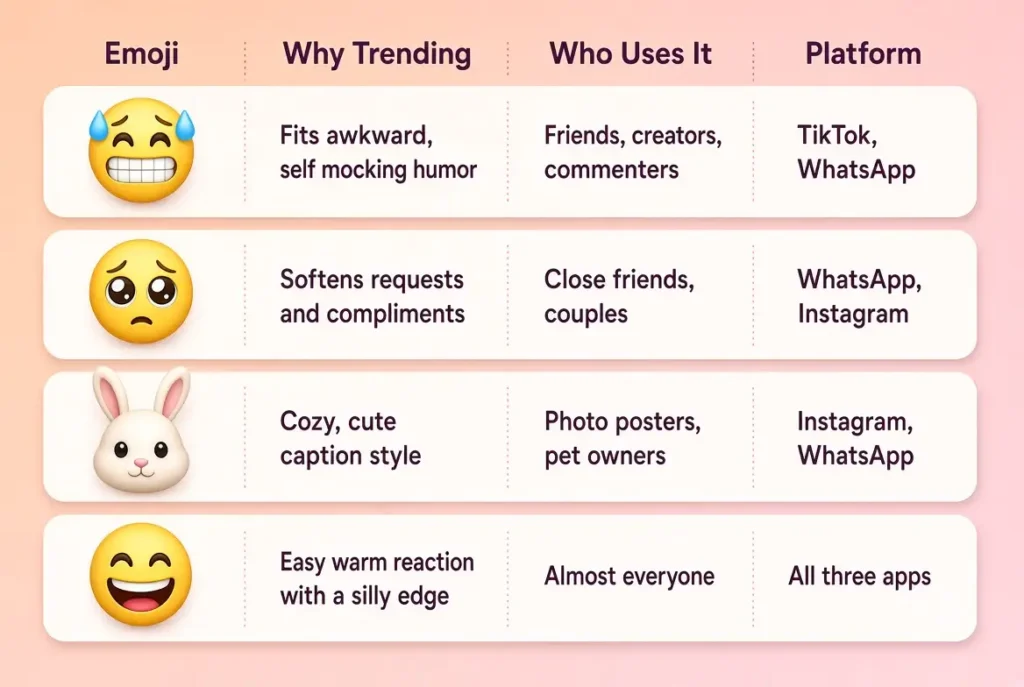
Among trending emojis in 2026, a few from this family keep showing up in chats and comments. These are general patterns based on how people tend to text and post, not hard numbers.
😬 fits the self mocking humor that fills comment sections. Friends, creators, and commenters use it on TikTok and WhatsApp to say “that was awkward, and I know it.” It works because it lets people laugh at themselves before anyone else does.
🥺 softens requests and compliments. Close friends and couples send it on WhatsApp and Instagram when they want a message to feel gentle. It pairs easily with the cute animals in this family.
🐰 suits cozy, aesthetic captions. Photo posters and pet owners use it on Instagram, and friends use it in private chats for a sweet tone. It fits the soft, cozy look many people want in their feeds.
😁 is the easy everyday reaction. Nearly everyone uses it across all three apps, often with a silly edge. Because it’s so familiar, it rarely needs an explanation.
| Emoji | Why trending | Who uses it | Platform |
| 😬 | Fits awkward, self mocking humor | Friends, creators, commenters | TikTok, WhatsApp |
| 🥺 | Softens requests and compliments | Close friends, couples | WhatsApp, Instagram |
| 🐰 | Cozy, cute caption style | Photo posters, pet owners | Instagram, WhatsApp |
| 😁 | Easy warm reaction with a silly edge | Almost everyone | All three apps |
Emoji language keeps shifting as memes and inside jokes give familiar faces new jobs.
FAQ
What is the most popular buckteeth emoji?
There’s no official ranking. Many people pick 😁 for the toothy grin and 🐰 for the cute look, but it varies by friend group.
What does 😁 mean from a girl or boy?
Gender matters less than context. Look at your relationship, the topic, and how the chat has been going. A grin between close friends can mean something very different from one sent by a coworker.
Why do emojis look different on iPhone vs Android?
Each platform draws its own art for the same Unicode code. The meaning stays put, but the style changes, so a grin may look rounder or goofier on another phone.
Are buckteeth emoji used differently in other countries?
Yes, they can be. Emoji meaning shifts with culture, language, and even friend group. If you chat across countries, a quick follow up question clears up most confusion.
Final thoughts
Keep it light, match the mood of the chat, and think about who’s on the other end. Pick one or two from the list and send them without overthinking it. A little goofiness goes a long way in digital conversations.

About Matiullah Mughal
Matiullah Mughal is a writer and digital content creator at AuthorityNoria, a platform dedicated to helping people understand emoji meanings, symbols, expressions, and modern digital communication.
With a passion for clear and useful online content, Matiullah Mughal researches the meanings, uses, and cultural context behind emojis and symbols to make digital communication easier to understand. His goal is to turn confusing or unfamiliar emojis into simple, practical explanations that readers can quickly understand and use.
At AuthorityNoria, Matiullah Mughal focuses on creating helpful, easy-to-read guides covering emoji meanings, emoji combinations, symbols, texting expressions, social media communication, and digital language.
Through his work, he aims to help readers choose the right emoji, understand what others mean, and communicate their feelings more clearly in everyday conversations.
When he’s not writing, Matiullah Mughal enjoys exploring new digital trends, online communication, and the constantly changing language of the internet.