Sometimes a laugh needs a face, not just words.
You’re texting a friend, they send something ridiculous, and typing “haha” just doesn’t cut it anymore. So you reach for an amused emoji instead, hoping it lands the way you mean it to. But with so many laughing faces available on your keyboard, it’s easy to wonder which one actually fits the moment. Are 😂 and 🤣 really the same thing? Does 😅 mean you’re laughing, relieved, or just a little embarrassed? This guide breaks down every common amused emoji so you can text with more confidence, whether you’re chatting, commenting, or writing a caption.
“Sometimes one small emoji says more than an entire sentence.”
What do amused emoji mean?
An amused emoji shows that something struck you as funny, silly, or lighthearted. It can mean genuine laughter, gentle teasing, or a playful reaction to a joke. The exact feeling depends on which face you choose and the tone of the conversation around it.
There isn’t just one amused emoji. There’s a whole family of laughing faces, and each one carries a slightly different flavor of humor. Some show pure joy, others show nervous laughter, and a few lean into sarcasm or teasing.
😂 Face with Tears of Joy is the most common choice for everyday funny moments. It works for almost anything that makes you laugh out loud, from a friend’s joke to a random meme.
🤣 Rolling on the Floor Laughing takes things a step further. Use it when something is so funny you can barely handle it. It reads as more intense than 😂.
😆 Grinning Squinting Face shows happy, satisfied laughter. It’s a good pick when you’re genuinely delighted, not just mildly amused.
😄 Grinning Face with Smiling Eyes feels warm and cheerful. It works well for friendly banter and light conversations.
😅 Grinning Face with Sweat is trickier. It can mean nervous laughter, relief, or amusement mixed with a little awkwardness, so context matters here more than usual.
🙃 Upside-Down Face often signals irony or sarcasm rather than straightforward amusement. It’s the emoji version of a knowing smirk.
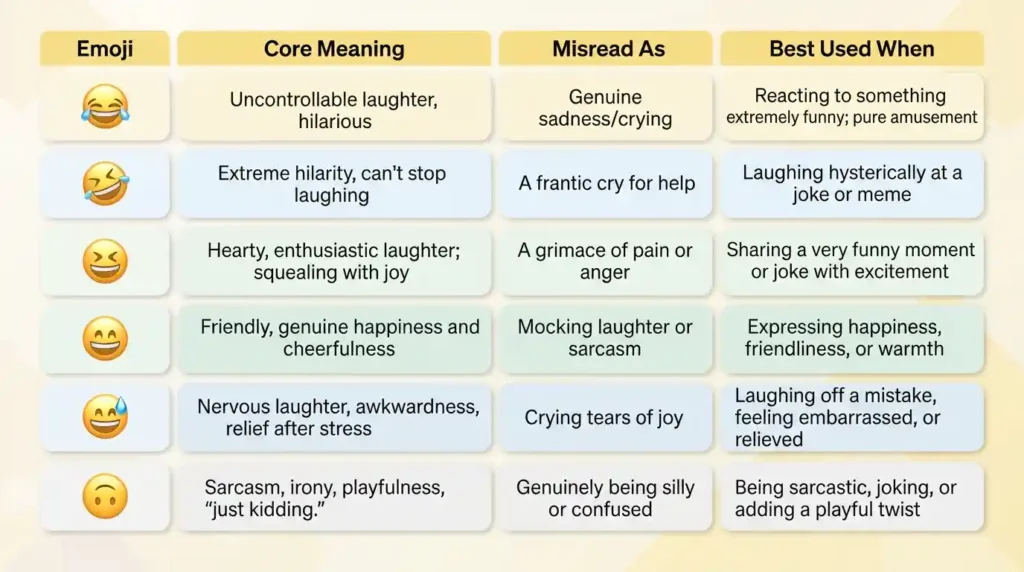
| Emoji | Core meaning | Misread as | Best used when |
| 😂 | Genuine laughter | Overused, low effort | Reacting to something funny |
| 🤣 | Intense, uncontrollable laughter | Sarcastic mocking | Something is hilarious |
| 😆 | Happy, satisfied laughter | Nervousness | You’re delighted by a joke |
| 😄 | Warm, cheerful amusement | Forced positivity | Friendly, upbeat chats |
| 😅 | Nervous or relieved laughter | Pure joy | Awkward or tense moments |
| 🙃 | Playful irony or sarcasm | Genuine happiness | Saying one thing, meaning another |
Amused Emoji Cards
😂 Face with Tears of Joy Meaning: Genuine laughter at something funny, the go-to reaction emoji for humor. Example 1: That video killed me 😂 Example 2: You’re not wrong 😂
🤣 Rolling on the Floor Laughing Meaning: Intense, over-the-top amusement, stronger than a regular laugh. Example 1: I can’t stop laughing 🤣 Example 2: He actually said that 🤣
😆 Grinning Squinting Face Meaning: Happy, satisfied laughter with a lighthearted tone. Example 1: That joke was too good 😆 Example 2: We laughed the whole way home 😆
😄 Grinning Face with Smiling Eyes Meaning: Warm, cheerful amusement and genuine good mood. Example 1: Today has been so fun 😄 Example 2: Glad you’re here 😄
😁 Beaming Face with Smiling Eyes Meaning: Big, excited amusement, often paired with good news or humor. Example 1: We’re finally doing this 😁 Example 2: I knew you’d say that 😁
😅 Grinning Face with Sweat Meaning: Nervous, relieved, or slightly awkward laughter. Example 1: That was close 😅 Example 2: Oops, my bad 😅
😹 Cat with Tears of Joy Meaning: Playful, cute amusement, often used in casual or informal chats. Example 1: Your cat did what 😹 Example 2: This is too funny 😹
😝 Squinting Face with Tongue Meaning: Playful teasing, silly amusement between friends. Example 1: Caught you 😝 Example 2: Not falling for that 😝
😜 Winking Face with Tongue Meaning: Joking, silly amusement paired with a wink. Example 1: Just kidding 😜 Example 2: You know I’m right 😜
🙃 Upside-Down Face Meaning: Playful irony, sarcasm, or a joke with a twist. Example 1: Sure, that’ll work 🙃 Example 2: Great, another Monday 🙃
How to use amused emoji the right way
WhatsApp chats tend to be personal and casual, so amused emoji fit naturally into everyday banter. A quick 😂 or 🤣 after a funny voice note keeps the conversation light, and it often does more work than a written reply would.
Close friends and family often stack laughing emoji for emphasis, sending two or three in a row when something is genuinely funny. With acquaintances or work contacts, though, one is usually enough to get the point across without feeling excessive.
On Instagram, amused emoji show up most in comments and captions. A 😂 under a funny post reads as a quick, genuine reaction, and it’s often faster to type than an actual sentence.
For captions, 😆 or 😄 works well when you want the post itself to feel upbeat rather than purely reactive. These softer laughing faces suit posts about good days, inside jokes, or lighthearted moments you’re sharing with followers.
TikTok
TikTok comments thrive on humor, so 🤣 and 😹 are everywhere here. They’re used to react to jokes, ironic edits, and unexpected punchlines, often standing in for an entire comment on their own.
🙃 is common when a comment is meant to sound sarcastic or self-aware rather than sincerely amused, especially under videos that lean into irony or deadpan humor. Because TikTok’s comment culture moves fast, these emoji act as a shortcut for tone that words alone might not capture quickly enough.
Dos
- Use the emoji when it matches the emotional tone.
- Consider your relationship with the person.
- Use combinations that feel natural.
Don’ts
- Do not overload serious messages with emojis.
- Do not assume everyone interprets an emoji the same way.
- Do not use an emoji combination that changes the intended tone.
Best amused emoji combos — copy & paste
Romantic
👉 😄❤️ — Telling someone their humor is part of why you love them 👉 😂💕 — Laughing together during a sweet, playful moment 👉 🙃💘 — A teasing, flirty line that still feels affectionate
Cute
👉 😹🐾 — Reacting to a funny pet video or story 👉 😝✨ — A silly, adorable joke between close friends 👉 😆🌸 — Light, cheerful laughter in a casual chat
Flirty
👉 😜😉 — Playful teasing with a hint of flirtation 👉 🙃😏 — A sarcastic comment meant to spark a reaction 👉 😅💬 — Nervous, giggly energy in an early conversation
Missing someone
👉 😂🥹 — Remembering an inside joke that still makes you laugh 👉 😄💭 — Thinking back on a funny memory together 👉 🤣📱 — Wishing they were there to laugh with you now
Good night
👉 😄🌙 — Ending the day on a lighthearted note 👉 😆💤 — A last laugh before signing off 👉 😹🌟 — A playful, cozy goodnight message
Trending amused emoji in 2026
🤣 continues to dominate casual, high-energy reactions, especially in comment sections where a single emoji needs to carry a big laugh without any extra text. It’s the kind of reaction that works whether the joke is a meme, a video, or a friend’s message.
😹 has grown popular among younger users who favor animal emoji for a softer, more playful tone than the standard laughing face. It shows up often under pet videos, cute mishaps, and lighthearted stories where a straightforward 😂 might feel a bit too plain.
🙃 keeps showing up in ironic or deadpan comments, especially where the text alone might read as too sincere or too blunt. People use it to add a wink of sarcasm to an otherwise ordinary sentence, letting the reader know not to take the words too literally.
😅 remains common in group chats, where it doubles as a way to laugh something off without sounding overly dramatic. It’s especially useful when a message needs to carry both humor and a little bit of relief at the same time.
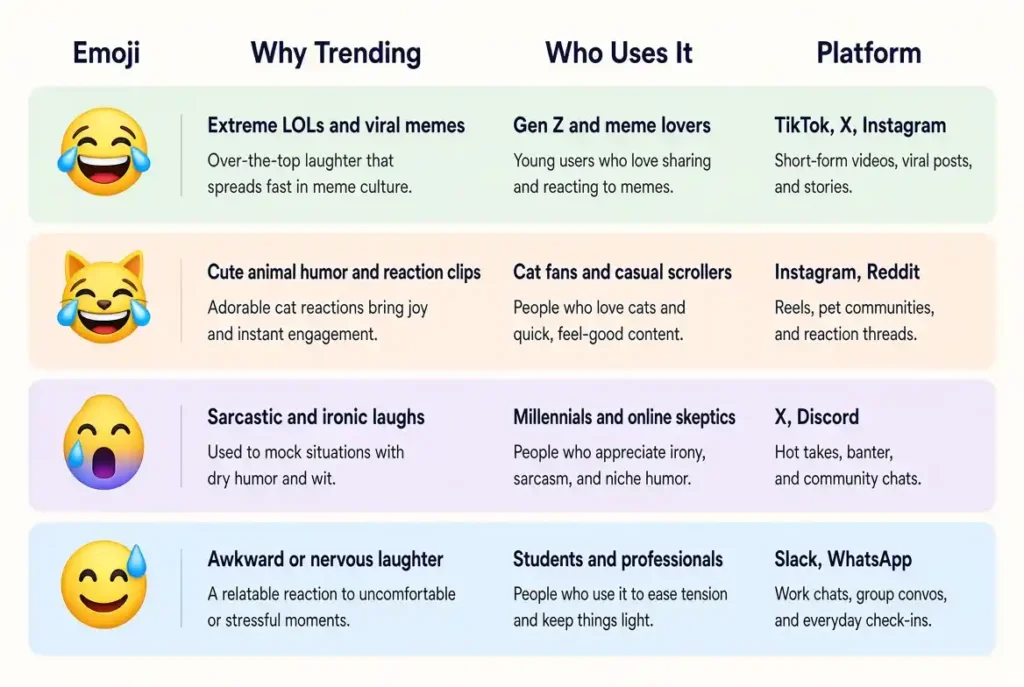
| Emoji | Why trending | Who uses it | Platform |
| 🤣 | Signals big, unmistakable amusement | Casual chatters, comment sections | TikTok, Instagram |
| 😹 | Softer, cuter alternative to standard laughing faces | Younger users, pet content fans | TikTok, WhatsApp |
| 🙃 | Adds irony or sarcasm to short replies | Users who favor dry humor | Instagram, TikTok |
| 😅 | Balances laughter with a touch of awkwardness | Group chat participants | WhatsApp, group texts |
Emoji communication keeps shifting as new faces get added and old ones take on fresh meanings depending on how people actually use them.
FAQ
What is the most popular amused emoji?
😂 remains one of the most widely used amused emoji across most platforms. It works for nearly any funny moment, which is why it shows up so often in everyday texting.
What does the amused emoji mean from a girl or boy?
Meaning depends more on context, relationship, and conversation than on who’s sending it. The same emoji can be playful, teasing, or purely reactive depending on how it’s used.
Why do emojis look different on iPhone vs Android?
Different operating systems and apps design their own versions of each emoji while following shared Unicode standards. That’s why the same emoji can look slightly different depending on the device.
Are amused emoji used differently in other countries?
Emoji interpretation can vary by culture and context, even when the same symbol is used. What reads as playful in one place might come across differently somewhere else.
Conclusion
Amused emoji make texting feel more human, turning a flat message into something that actually sounds like laughter. Once you know the small differences between them, picking the right one becomes second nature. Use them where they fit naturally, and let the conversation guide the tone. A well-placed laughing face still says more than words alone.

About Matiullah Mughal
Matiullah Mughal is a writer and digital content creator at AuthorityNoria, a platform dedicated to helping people understand emoji meanings, symbols, expressions, and modern digital communication.
With a passion for clear and useful online content, Matiullah Mughal researches the meanings, uses, and cultural context behind emojis and symbols to make digital communication easier to understand. His goal is to turn confusing or unfamiliar emojis into simple, practical explanations that readers can quickly understand and use.
At AuthorityNoria, Matiullah Mughal focuses on creating helpful, easy-to-read guides covering emoji meanings, emoji combinations, symbols, texting expressions, social media communication, and digital language.
Through his work, he aims to help readers choose the right emoji, understand what others mean, and communicate their feelings more clearly in everyday conversations.
When he’s not writing, Matiullah Mughal enjoys exploring new digital trends, online communication, and the constantly changing language of the internet.