
That side glance in emoji form? Let’s decode it.
You get a message at midnight. No words, just 👀🐟. Is your friend teasing you, flirting, or fishing for gossip? That confusion is why so many people search for fisheye emoji meaning. There’s no official emoji with that name, so people usually mean the eyes and fish family: a watchful look, a hint of suspicion, or a playful hook. The meaning shifts with who sends it and how. Here’s a plain guide to what these emojis mean, how to use them, and what to copy and paste.
“A single glance can start a whole conversation.”
What do fisheye emojis mean?
Fisheye emojis usually mean a watchful, curious, or suspicious look. 👀 shows interest or gossip, 🐟 plays on the word “fishy,” and face emojis like 😒 and 🙄 add attitude. The exact meaning depends on tone, relationship, and the conversation. There is no single official fisheye emoji, so context decides.
Think of it as a mood, not a fixed symbol. A glance can be playful with a friend and cold with a stranger.
Here are six that show up most often:
👀 is the all purpose “I’m watching” emoji. It can mean interest, curiosity, or “tell me more.” Sent after a juicy update, it’s friendly. Sent after an awkward comment, it can feel pointed.
🐟 often shows up when something seems off. People use it as a pun on “fishy.” Less often, it hints that someone is fishing for compliments.
😒 signals mild annoyance or doubt. It’s a quiet “really?” that works best with people who know your humor.
🙄 is the classic eye roll. It can be playful teasing or real irritation, so tone matters a lot.
😏 adds a knowing, flirty edge. It says “I see what you’re doing” in a way that’s often teasing.
🫣 is the shy peek. It works for embarrassment, nervous excitement, or “I can’t look, but I want to.”
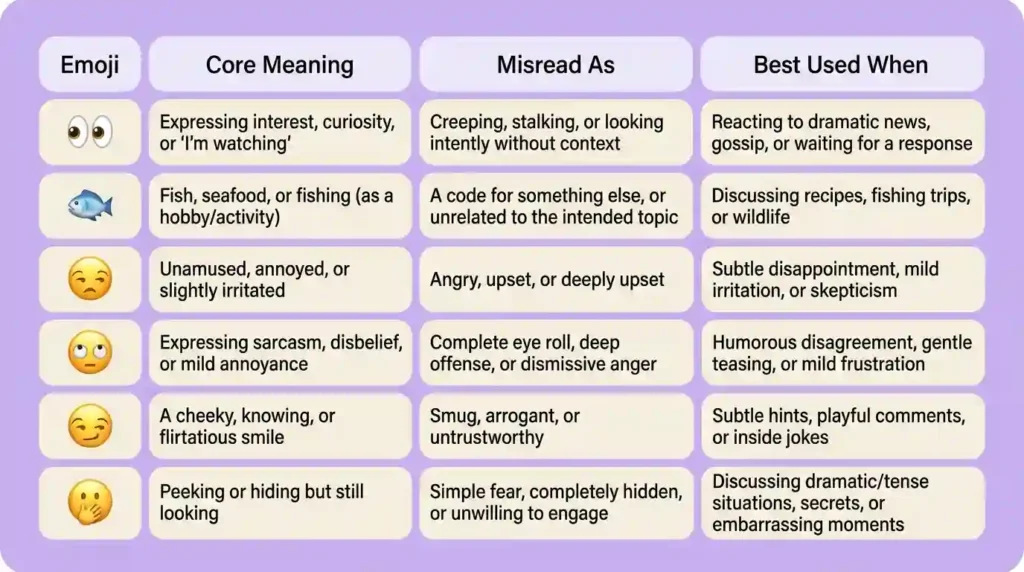
| Emoji | Core meaning | Misread as | Best used when |
| 👀 | Interest, watching | Spying or judging | Reacting to news or gossip |
| 🐟 | Something feels fishy | Random fish talk | Joking about a weird story |
| 😒 | Doubt, mild annoyance | Real anger | Teasing a close friend |
| 🙄 | Eye roll, playful tease | Disrespect | Reacting to a cheesy joke |
| 😏 | Knowing, flirty smirk | Smugness | Light flirting |
| 🫣 | Shy peek | Fear | Feeling bashful or excited |
More Meanings
👀 Eyes
Meaning: Curiosity, attention, and a “this is interesting” reaction.
Example 1: Wait, you two are together now 👀
Example 2: New photos just dropped 👀
👁️ Eye
Meaning: Watching closely, awareness, or a dramatic stare.
Example 1: I’m keeping an eye on you 👁️
Example 2: Someone is always watching 👁️
🐟 Fish
Meaning: Suspicion or a pun on something fishy.
Example 1: That excuse sounds fishy 🐟
Example 2: Something is off here 🐟
🐠 Tropical Fish
Meaning: Cute, calm, and playful energy.
Example 1: Swimming through my Monday 🐠
Example 2: You make me smile 🐠
🎣 Fishing Pole
Meaning: Fishing for attention, compliments, or information.
Example 1: Are you fishing for a compliment 🎣
Example 2: Just casting a hint 🎣
🧿 Nazar Amulet
Meaning: Protection from the evil eye and bad vibes.
Example 1: Wishing you a safe trip 🧿
Example 2: Protect this good news 🧿
🙄 Face With Rolling Eyes
Meaning: Playful annoyance, disbelief, or teasing.
Example 1: You said five minutes an hour ago 🙄
Example 2: Okay, drama king 🙄
😒 Unamused Face
Meaning: Doubt, boredom, or mild side eye.
Example 1: Sure, you “forgot” 😒
Example 2: I heard that 😒
🤨 Face With Raised Eyebrow
Meaning: Skepticism and a questioning look.
Example 1: You really did the dishes 🤨
Example 2: That’s your story 🤨
😍 Heart Eyes
Meaning: Admiration, crush energy, and strong liking.
Example 1: That view is unreal 😍
Example 2: You look amazing 😍
How to use fisheye emojis the right way
Emojis are Unicode characters, so every phone can send them. But each app shows its own artwork, and each crowd has its own habits. Here’s how people tend to use them.
WhatsApp chats are personal and casual. People use 👀 to react to a voice note or a big update. 🙄 and 😒 work for teasing close friends, while 🫣 fits shy or nervous moments.
Instagram is about captions, comments, and aesthetic posts. 🐠 suits calm, pretty photos. 😍 and 👀 are common reactions under a friend’s new picture.
TikTok
TikTok comments lean funny and ironic. 👀 shows up under dramatic clips, and 🤨 or 😒 can mark a “nice try” moment. Humor changes fast here, so match the tone of the thread.
Dos
- Use the emoji when it matches the emotional tone.
- Consider your relationship with the person.
- Use combinations that feel natural.
Don’ts
- Do not overload serious messages with emojis.
- Do not assume everyone interprets an emoji the same way.
- Do not use an emoji combination that changes the intended tone.
Best fisheye emoji combos: copy and paste
Tap, copy, and send. Each one is short and easy to adapt.
Romantic
😍👁️ Use when you can’t stop looking at someone
🐠😍 Use for a soft, happy compliment
🧿😍 Use to wish someone well with love
Cute
🐠👀 Use for a sweet “hey, I see you”
🫣🐠 Use when you feel a little shy
🐟😍 Use for a silly, loving reaction
Flirty
😏👀 Use for a playful “I noticed that”
🎣😏 Use when you’re fishing for a compliment
😍🫣 Use when you like someone but feel nervous
Missing someone
👀🐠 Use when you’re waiting for their reply
🫣👁️ Use when you keep checking your phone
🧿😍 Use to say “stay safe, I miss you”
Good night
🐠🧿 Use for a calm “sleep well”
😍🐠 Use for a sweet last message
👀🧿 Use for “see you in my dreams, stay protected”
Trending fisheye emojis in 2026
These are general patterns, not hard numbers. Emoji habits shift quickly, and different groups use them differently.
👀 keeps showing up in group chats and comment sections. Younger and older users both use it to react to news or drama. It fits quick, low effort replies.
🫣 appears often in flirty or awkward moments. People use it in WhatsApp chats and Instagram comments when they feel shy but interested.
🐠 is common in soft, aesthetic captions. It’s seen mostly on Instagram, where calm and pretty visuals are popular.
🧿 is popular in messages that wish someone good luck or protection. It’s often seen in chats among friends and family, and on posts about celebrations and travel.
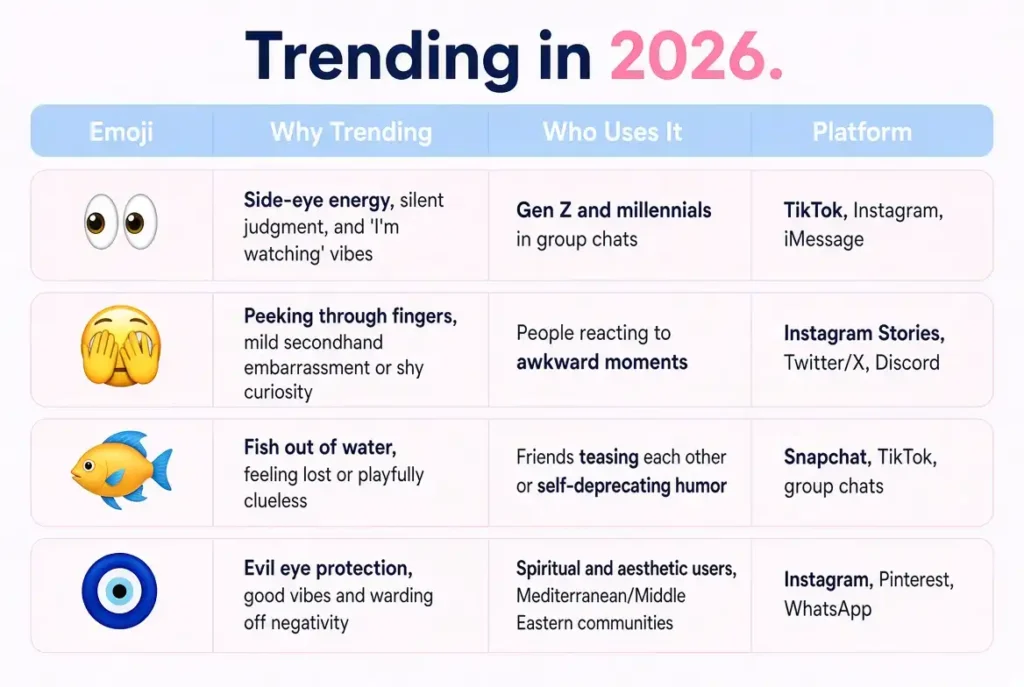
| Emoji | Why trending | Who uses it | Platform |
| 👀 | Quick reaction to news | Most age groups | WhatsApp, TikTok |
| 🫣 | Shy, flirty moments | Friends, couples | WhatsApp, Instagram |
| 🐠 | Soft, aesthetic mood | Casual posters | |
| 🧿 | Luck and protection | Friends, family | WhatsApp, Instagram |
Emoji language keeps changing as people find new ways to say small things.
FAQ
What is the most popular fisheye emoji?
👀 is the one most people reach for. It’s quick, flexible, and easy to read in almost any chat.
What does 👀 mean from a girl or boy?
Gender matters less than context. Look at the relationship, the topic, and the tone of the conversation to understand what the sender means.
Why do emojis look different on iPhone vs Android?
Each platform draws its own version of an emoji. They all follow Unicode standards, so the meaning stays the same even when the artwork changes.
Are fisheye emojis used differently in other countries?
Yes, sometimes. Culture and context shape how people read an emoji, so a friendly glance in one place can feel odd in another.
Conclusion
Fisheye emojis work best when they match your mood and your audience. Start with a simple one like 👀, then add others as you get comfortable. When in doubt, keep it light and let the conversation guide you.

About Matiullah Mughal
Matiullah Mughal is a writer and digital content creator at AuthorityNoria, a platform dedicated to helping people understand emoji meanings, symbols, expressions, and modern digital communication.
With a passion for clear and useful online content, Matiullah Mughal researches the meanings, uses, and cultural context behind emojis and symbols to make digital communication easier to understand. His goal is to turn confusing or unfamiliar emojis into simple, practical explanations that readers can quickly understand and use.
At AuthorityNoria, Matiullah Mughal focuses on creating helpful, easy-to-read guides covering emoji meanings, emoji combinations, symbols, texting expressions, social media communication, and digital language.
Through his work, he aims to help readers choose the right emoji, understand what others mean, and communicate their feelings more clearly in everyday conversations.
When he’s not writing, Matiullah Mughal enjoys exploring new digital trends, online communication, and the constantly changing language of the internet.