Those little red envelopes and lanterns say more than you think.
You get a message from a friend, and it’s just 🧧 and 🏮 with no words. Is it a greeting, a blessing, or a joke? That’s why so many people search for Chinese emoji meanings. These symbols carry holiday, food, and tradition into everyday chats. Some are easy to read, while others change with context. Once you know how they’re used, you can reply with confidence. Let’s break down what each one means and how to use it without any awkward moments or mixed signals.
“One small emoji can carry a whole tradition.”
What do Chinese emojis mean?
Chinese emojis are symbols tied to Chinese culture, like 🧧 for luck and gifts, 🏮 for festivals, and 🥟 for food and family. Most people use them to share celebrations, good wishes, and warmth. The meaning shifts with context, so a dragon can mean power in one chat and playful energy in another.
Here is how context can change the message.
🧧 usually brings good luck, but in a chat about money it can hint at a payment or a treat. Your tone decides which one you mean.
🏮 sets a festive mood. Sent alone, it looks like a holiday greeting. Sent late at night, it can feel calm and a little nostalgic.
🐉 reads as strength and good fortune to many people. Others just see a fun animal, so the words around it matter.
🧨 signals a party for most. In a tense conversation, it can look like noise or drama.
🥟 often points to food, but it can also suggest a family table. In a casual chat, it may simply mean “I’m hungry.”
🀄 links to mahjong, yet people also use it as a playful sign of luck or a game night invite.
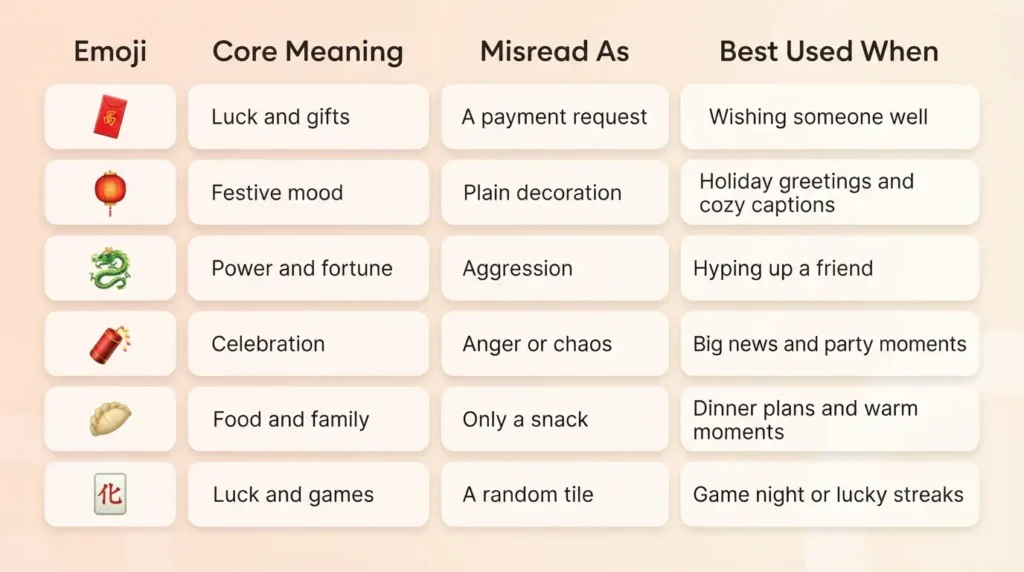
| Emoji | Core meaning | Misread as | Best used when |
| 🧧 | Luck and gifts | A payment request | Wishing someone well |
| 🏮 | Festive mood | Plain decoration | Holiday greetings and cozy captions |
| 🐉 | Power and fortune | Aggression | Hyping up a friend |
| 🧨 | Celebration | Anger or chaos | Big news and party moments |
| 🥟 | Food and family | Only a snack | Dinner plans and warm moments |
| 🀄 | Luck and games | A random tile | Game night or lucky streaks |
More Meanings
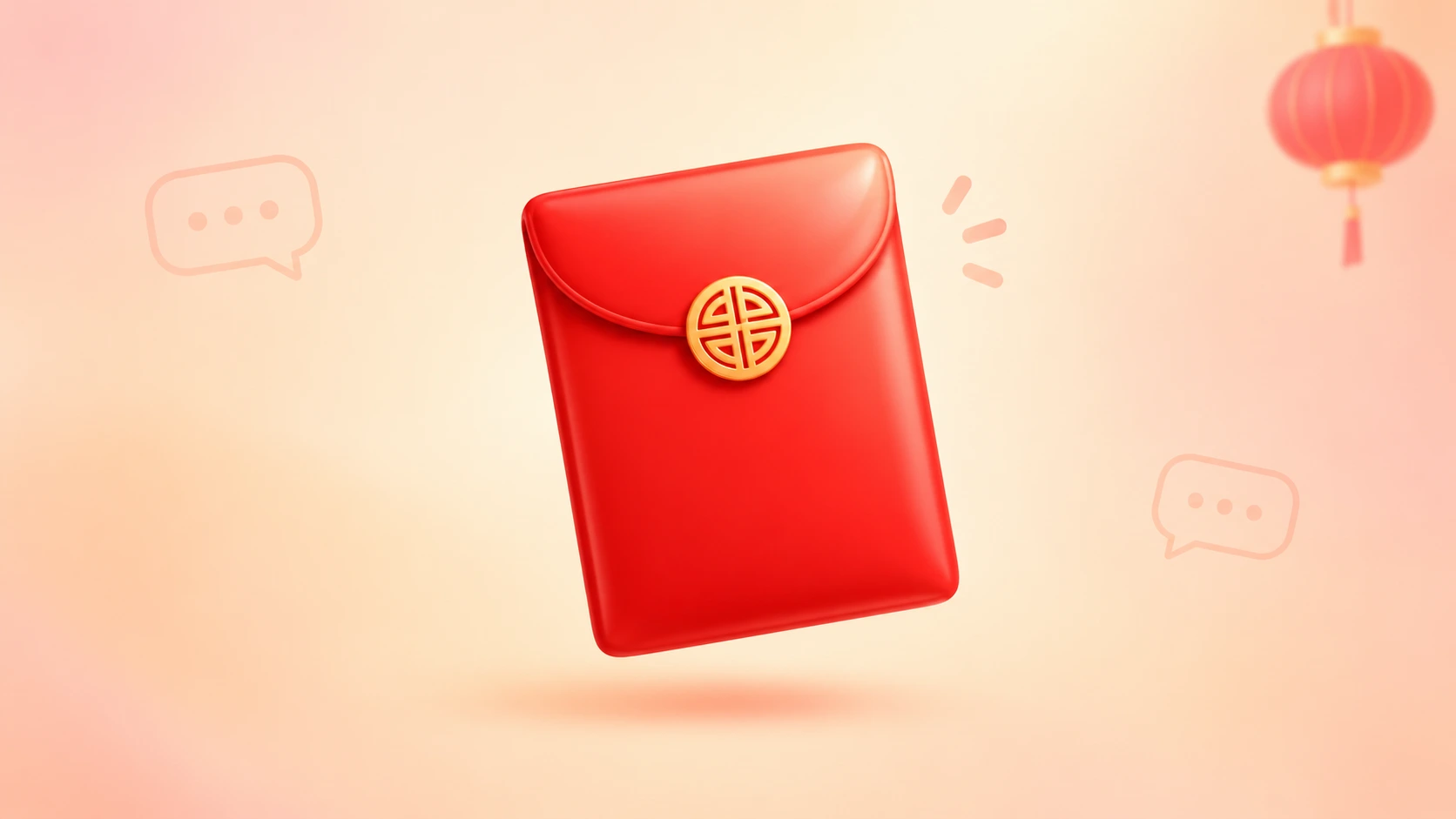
🧧 Red Envelope
Meaning: Luck, blessings, and gifts shared at celebrations.
Example 1: Happy new year 🧧
Example 2: Wishing you luck this week 🧧
🏮 Red Lantern
Meaning: Festival spirit, warmth, and tradition.
Example 1: Lights are up everywhere 🏮
Example 2: Such a cozy evening 🏮
🐉 Dragon
Meaning: Strength, power, and good fortune.
Example 1: You’ve got this 🐉
Example 2: Big energy today 🐉
🧨 Firecracker
Meaning: Celebration, excitement, and a loud send off.
Example 1: We got the news 🧨
Example 2: Let’s make tonight loud 🧨
🥟 Dumpling
Meaning: Comfort food, family meals, and togetherness.
Example 1: Dinner at my place 🥟
Example 2: Mom’s cooking again 🥟
🥮 Mooncake
Meaning: Reunion, sharing, and Mid Autumn memories.
Example 1: Saving you a piece 🥮
Example 2: Family night is the best 🥮
🀄 Mahjong Red Dragon
Meaning: Luck, games, and playful rivalry.
Example 1: Game night is on 🀄
Example 2: Feeling lucky today 🀄
🐼 Panda
Meaning: Softness, calm, and gentle charm.
Example 1: Sleepy mood today 🐼
Example 2: You’re so sweet 🐼
🍵 Teacup Without Handle
Meaning: Calm, hospitality, and slow moments.
Example 1: Come over for tea 🍵
Example 2: Taking a quiet break 🍵
🥢 Chopsticks
Meaning: Shared meals and dining together.
Example 1: Lunch together soon 🥢
Example 2: Let’s try that new place 🥢
How to use Chinese emojis the right way
Every app treats emojis a little differently, so it helps to know the tone of each platform. Use them like seasoning, not the main dish.
WhatsApp chats are personal, so warm and casual picks work best. A 🧧 in a family group during a holiday feels natural.
Close friends can trade 🥟 and 🍵 for dinner plans or comfort. Keep it simple in work groups.
On Instagram, emojis shape the mood of a caption. A 🏮 or 🐼 next to a cozy photo sets a soft, aesthetic tone.
In comments, one emoji is often enough. A single 🐉 under a friend’s win says plenty.
TikTok
TikTok comments are funny and playful. People drop 🧨 for big moments and 🀄 for jokes about luck or rivalry.
Irony is common here. A serious emoji under a silly video is often a joke, not a statement.
Dos
- Use the emoji when it matches the emotional tone.
- Consider your relationship with the person.
- Use combinations that feel natural.
Don’ts
- Do not overload serious messages with emojis.
- Do not assume everyone interprets an emoji the same way.
- Do not use an emoji combination that changes the intended tone.
One more thing to know: the same emoji can look different on your friend’s phone. Unicode sets the standard code for each emoji, but Apple, Google, and Samsung draw their own versions. If a 🥟 looks odd, that’s design, not a mistake.
Best Chinese emoji combos: copy and paste
Tap, copy, and send. Each combo below is built from the same small set.
Romantic
🥮🌕 : A Mid Autumn wish for someone you love
🧧🏮 : Wishing your partner a lucky year ahead
🍵🥮 : Planning a cozy date together
Cute
🐼🥟 : A sweet, snack loving mood
🐼🍵 : A calm and cuddly day
🥟🥢 : A cute dinner invite
Flirty
🐉🧧 : Teasing that you’re their lucky charm
🧨🐉 : Bringing the fireworks tonight
🀄🧧 : Hinting you’re a good bet
Missing someone
🌕🥟 : Missing family dinners and wishing you were there
🏮🌕 : Looking at the same moon and thinking of you
🍵🥢 : Missing slow meals and long chats
Good night
🌕🍵 : Winding down with tea under the moon
🐼🌕 : A sleepy sign off
🏮🍵 : A soft, glowing goodnight
Trending Chinese emojis in 2026
These are general patterns people seem to notice, not hard numbers. Usage keeps shifting from group to group.
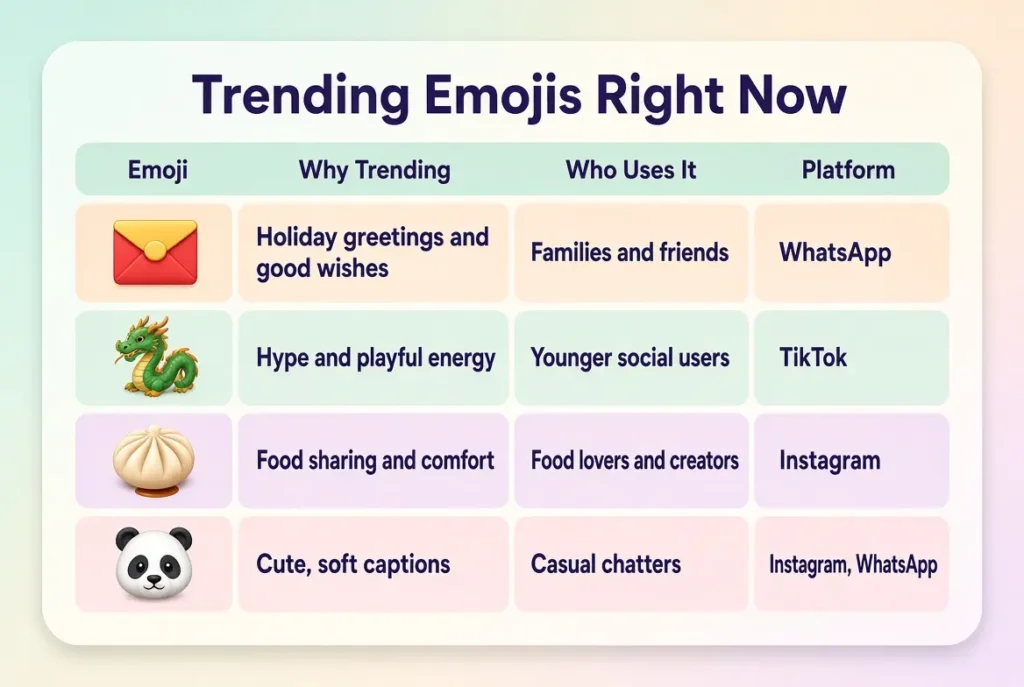
🧧 shows up in group chats around holidays and celebrations. Families and friends use it for warm greetings, and it fits the digital gifting feel of modern messaging.
🐉 appears in hype comments and short video replies. Younger users on TikTok often use it to cheer someone on or add playful drama.
🥟 is common in food posts, reels, and dinner chats. It matches the relaxed, share your meal style of social media today.
🐼 turns up in cute captions and soft, cozy messages. People use it on Instagram and WhatsApp when they want a gentle tone.
| Emoji | Why trending | Who uses it | Platform |
| 🧧 | Holiday greetings and good wishes | Families and friends | |
| 🐉 | Hype and playful energy | Younger social users | TikTok |
| 🥟 | Food sharing and comfort | Food lovers and creators | |
| 🐼 | Cute, soft captions | Casual chatters | Instagram, WhatsApp |
Emoji communication keeps changing as people find new ways to mix tradition with everyday chat.
FAQ
What is the most popular Chinese emoji?
Many people reach for 🧧 first, especially around celebrations. It’s easy to understand and fits many warm messages.
What does 🧧 mean from a girl or boy?
The meaning depends more on context, relationship, and the conversation than on gender. A 🧧 from a friend is usually a kind wish, while one from a partner may feel more personal.
Why do emojis look different on iPhone vs Android?
Each operating system and platform draws its own artwork. They all follow Unicode standards, so the meaning stays the same even when the design changes.
Are Chinese emojis used differently in other countries?
Yes, they can be. Culture, language, and local habits shape how people read an emoji, so context always helps.
Conclusion
Chinese emojis work best when they match the moment and the person you’re talking to. Start with a few favorites and use them the way you would speak. A little warmth goes a long way, and you’ll soon know what feels right.

About Matiullah Mughal
Matiullah Mughal is a writer and digital content creator at AuthorityNoria, a platform dedicated to helping people understand emoji meanings, symbols, expressions, and modern digital communication.
With a passion for clear and useful online content, Matiullah Mughal researches the meanings, uses, and cultural context behind emojis and symbols to make digital communication easier to understand. His goal is to turn confusing or unfamiliar emojis into simple, practical explanations that readers can quickly understand and use.
At AuthorityNoria, Matiullah Mughal focuses on creating helpful, easy-to-read guides covering emoji meanings, emoji combinations, symbols, texting expressions, social media communication, and digital language.
Through his work, he aims to help readers choose the right emoji, understand what others mean, and communicate their feelings more clearly in everyday conversations.
When he’s not writing, Matiullah Mughal enjoys exploring new digital trends, online communication, and the constantly changing language of the internet.