Ever sent a message and gotten back one tiny face with a hand on its chin?
You send a message you’re proud of, and the reply is just 🤔. No words. Now you’re staring at your screen wondering if they’re confused, annoyed, or quietly judging you.
That’s exactly why people search for thinking emoji meaning. The little yellow face looks simple, but it carries more than one mood. It can mean real curiosity, polite doubt, or a teasing challenge. Add different phones, apps, and friend groups, and the confusion makes sense. Here’s how to read it and use it with confidence.
“One tiny face can ask a question without typing a single word.”
What does the thinking emoji mean?
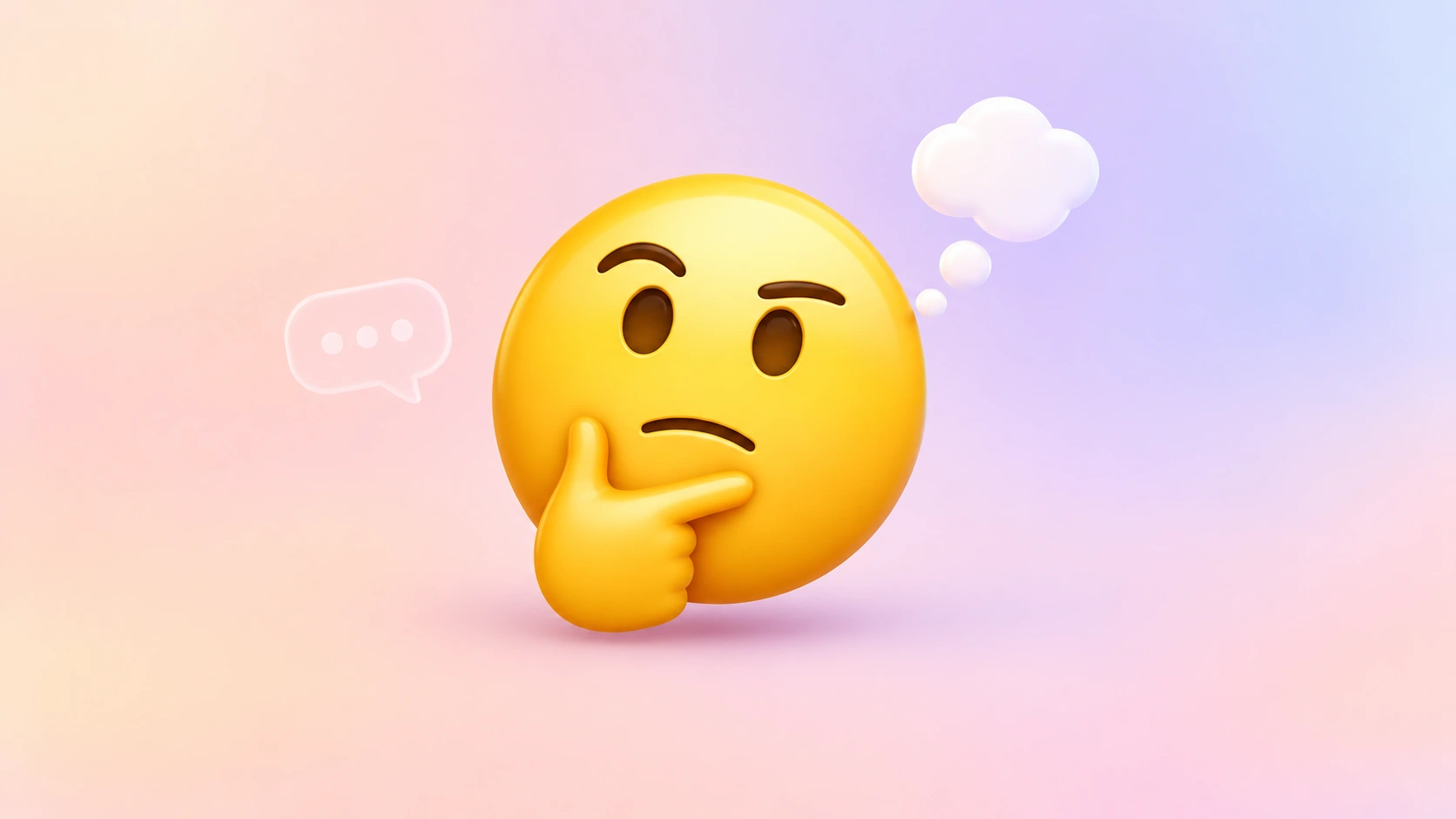
The thinking emoji 🤔 usually means someone is pondering, doubting, or weighing a decision. In casual chat it can also signal mild suspicion or a playful “hmm, really?” Tone and context decide the message, so the same face can sound curious, skeptical, or teasing depending on what surrounds it.
Every emoji is stored as a Unicode code, a shared standard that keeps the face recognizable on any phone. That’s why 🤔 looks familiar everywhere, even when each app draws it a little differently.
The classic 🤔 works like a quiet “hmm.” Sent alone, it’s neutral. After a big claim, it sounds doubtful.
🧐 feels more serious. It’s the face of someone inspecting a detail, or acting a little fancy about it.
🤨 adds a raised eyebrow. It’s sharper than 🤔 and leans toward suspicion.
💭 shows a thought bubble. People use it for daydreams and passing ideas.
🙄 looks like the next step when thinking turns into annoyance. Some people mix it up with 🤔, but the mood is much colder.
😏 brings a smirk. It turns the same thought into something playful or flirty.
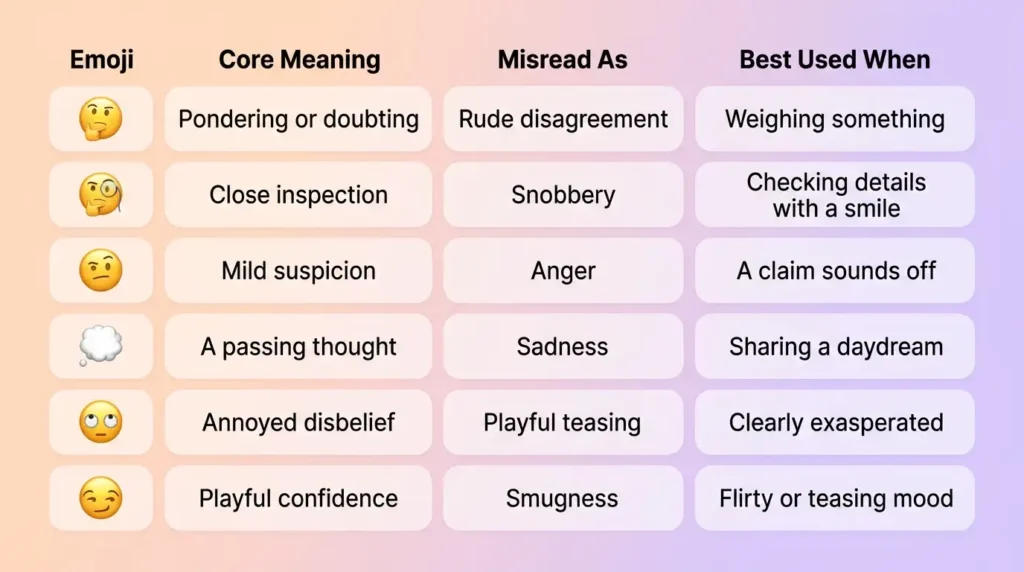
| Emoji | Core meaning | Misread as | Best used when |
| 🤔 | Pondering or doubting | Rude disagreement | You’re genuinely weighing something |
| 🧐 | Close inspection | Snobbery | You’re checking details with a smile |
| 🤨 | Mild suspicion | Anger | A claim sounds a bit off |
| 💭 | A passing thought | Sadness | You’re sharing a daydream or idea |
| 🙄 | Annoyed disbelief | Playful teasing | You’re clearly exasperated |
| 😏 | Playful confidence | Smugness | The mood is flirty or teasing |
More Meanings
🤔 Thinking Face
Meaning: Pondering, doubting, or weighing a choice.
Example 1: Pizza or tacos tonight 🤔
Example 2: Not sure that’s the right plan 🤔
🧐 Face with Monocle
Meaning: Examining something closely with curiosity.
Example 1: Let me look at this outfit again 🧐
Example 2: Interesting choice of font 🧐
🤨 Face with Raised Eyebrow
Meaning: Skepticism or mild suspicion.
Example 1: You “forgot” my birthday 🤨
Example 2: That story has gaps 🤨
💭 Thought Balloon
Meaning: A thought, daydream, or unspoken idea.
Example 1: Weekend trip someday 💭
Example 2: Wondering what’s next 💭
🙄 Face with Rolling Eyes
Meaning: Annoyance, disbelief, or dramatic impatience.
Example 1: Sure, you’ll wake up early 🙄
Example 2: Here we go again 🙄
😏 Smirking Face
Meaning: Playful confidence, teasing, or flirty hints.
Example 1: I might know something 😏
Example 2: You know exactly what you did 😏
😅 Grinning Face with Sweat
Meaning: Nervous humor or relief after an awkward moment.
Example 1: I may have overthought this 😅
Example 2: Okay, that was close 😅
🥺 Pleading Face
Meaning: Soft begging, shyness, or tender feelings.
Example 1: Can you stay a bit longer 🥺
Example 2: Please say yes 🥺
❤️ Red Heart
Meaning: Love, affection, and warmth.
Example 1: Thinking of you ❤️
Example 2: You make my day ❤️
😴 Sleeping Face
Meaning: Sleepiness, tiredness, or a wish to rest.
Example 1: Brain officially off 😴
Example 2: Time for bed 😴
How to use the thinking emoji the right way
The same face lands differently depending on where you send it. A good rule is to match the platform’s mood.
WhatsApp chats are personal and fast, so 🤔 works well for planning and gentle teasing. Friends read it as “let me think.” With family or coworkers, add a few words so the tone stays clear.
Colors and shapes can shift between phones. Your 🤔 may look slightly different on the receiving end, which is normal.
On Instagram, 💭 and 🤔 fit captions that hint at a mood without explaining it. A post of a sunset with “where to next 🤔” feels relaxed and open.
In comments, a lone 🤨 under a friend’s photo reads as playful. Under a stranger’s post, it can sound rude.
TikTok
TikTok comments lean on humor and irony. People drop 🤔 or 🧐 under videos to sound curious, or to question a bold claim.
It’s also common to pair it with 😏 for a joke the whole comment section understands. Trends move fast, so watch how other commenters use it first.
Dos
- Use the emoji when it matches the emotional tone.
- Consider your relationship with the person.
- Use combinations that feel natural.
Don’ts
- Do not overload serious messages with emojis.
- Do not assume everyone interprets an emoji the same way.
- Do not use an emoji combination that changes the intended tone.
Best thinking emoji combos: copy and paste
Each combo below is ready to copy. Pick the one that fits your mood.
Romantic
🤔💭❤️ Sweet way to say someone is on your mind
🤔❤️ Caption for a photo with your person
💭❤️😊 Sharing a daydream about a date
Cute
🤔😊 Friendly “what should we do” message
🤔😅 Admitting you’re overthinking something small
🤔🥺 Asking a favor in a soft way
Flirty
🤔😏 Teasing someone about a secret
🧐😏 Checking out a bold outfit with a wink
🤨😏 Playfully doubting a compliment
Missing someone
💭🥺 Quiet “I wish you were here”
🤔💭🥺 Wondering what they’re up to right now
💭🥺❤️ Honest and warm after a long day apart
Good night
😴💭 Drifting off with a thought of them
🌙🤔😴 Last “what if” before sleep
🌙💭❤️ Gentle goodnight with feeling
Trending thinking emoji in 2026
Nobody keeps an official score, so this section describes what people commonly do in chats and comments right now.
🤔 stays the everyday default. Friends use it for planning, doubts, and quick reactions. You’ll see it in group chats, replies, and comment sections.
🧐 shows up when people want to sound playfully dramatic. Younger users often use it in jokes, reviews, and mock “investigations.” It fits short videos and meme replies well.
🤨 works as a fast side eye. It appears in banter, reaction comments, and replies to bold claims. It matches the dry, ironic humor common in modern texting.
😏 pairs with the thinking face when the mood turns teasing. It’s common in flirty chats and playful captions. People like it because it hints at something without spelling it out.
| Emoji | Why trending | Who uses it | Platform |
| 🤔 | Quick, flexible reaction | Almost everyone | WhatsApp, Instagram |
| 🧐 | Playful, dramatic tone | Younger social media users | TikTok, Instagram |
| 🤨 | Dry, ironic humor | Friends in casual banter | TikTok, group chats |
| 😏 | Teasing and flirty hints | Close friends and couples | WhatsApp, Instagram |

Emoji communication keeps changing as people find new ways to blend faces, moods, and jokes.
FAQ
What is the most popular thinking emoji?
The classic 🤔 is the one most people mean when they say thinking emoji. It’s the most recognized face for pondering or doubt. Others like 🧐 and 💭 are common supporting choices.
What does 🤔 mean from a girl or boy?
Gender matters far less than context. The meaning depends on your relationship, the conversation, and the tone before the emoji. When in doubt, ask in plain words.
Why do emojis look different on iPhone vs Android?
Each company draws its own version of every emoji. They all follow the Unicode standard, which fixes the meaning and code, but not the exact artwork. So the idea stays the same while the style changes.
Are thinking emoji used differently in other countries?
Yes, sometimes. Culture, language, and local humor can shape how a face is read. A friendly “hmm” in one place may sound more skeptical somewhere else, so context matters.
Conclusion
Emojis work best when they support your words rather than replace them. Pay attention to who you’re talking to and how the conversation feels. If a message could be misread, add a few words. A small face is easy to send, but it’s even better when it sounds like you.

About Matiullah Mughal
Matiullah Mughal is a writer and digital content creator at AuthorityNoria, a platform dedicated to helping people understand emoji meanings, symbols, expressions, and modern digital communication.
With a passion for clear and useful online content, Matiullah Mughal researches the meanings, uses, and cultural context behind emojis and symbols to make digital communication easier to understand. His goal is to turn confusing or unfamiliar emojis into simple, practical explanations that readers can quickly understand and use.
At AuthorityNoria, Matiullah Mughal focuses on creating helpful, easy-to-read guides covering emoji meanings, emoji combinations, symbols, texting expressions, social media communication, and digital language.
Through his work, he aims to help readers choose the right emoji, understand what others mean, and communicate their feelings more clearly in everyday conversations.
When he’s not writing, Matiullah Mughal enjoys exploring new digital trends, online communication, and the constantly changing language of the internet.